Friday, December 15, 2006

Comics on Schools in Argentina

(escuela = school)


In the above comic excerpt, you get a sense of how a couple of Argentines see Argentine schools. This image comes from issue #2 of the recently initiated second volume of the legendary magazine Fierro. In this particulary story, cartoon versions of the writer and artist (Carlos Trillo and Oscar Grillo) are mysteriously transported back to their childhood lives and forced to relive that world with an adult perspective.

The school I visited (in which my cousin teachers) was formatted a bit like the one above, with dilapidated classrooms surrounding an inner courtyard. Note the prominent Argentine flag.

You could read about the original Fierro in the Rennaisance section I added (along with the Self-Publishing section) on the Argentine Comics Wikipedia page.


Wednesday, December 13, 2006

Bye, mom

My mom packed up and left Buenos Aires for the United States.

Tuesday, December 12, 2006

Volunteering III


Above, you could see the place where I've been volunteering. At one point today, I had to take away the materials to get kids to listen. After that, they achieved the two objectives that I explained (to color in the objects according to directions in English and to politely request materials if another student has what you need.)

Friday, December 08, 2006

New York


Sometimes I see this add with the Manhattan skyline. It makes me miss New York and everyone in it. I'm ready to leave Buenos Aires.

Cada dia hablo mejor

Algo raro me pasó hoy. Fui a un shopping y hablaba con el hombre quien me mostraba la ropa cuando, en vez del tipico “De donde sos?”, me preguntó “Sos de España?”. Pasó dos veces en dos tiendas. No tengo ni idea porque pensaban eso! Siempre trato de hablar en el dialecto glorioso rioplatense. Quizas pasó porque aparezco occidental y no hablo reyanqui, pero tampoco hablo bien porteño.


En un asado en la casa de Dani, el primo de mi madre, aprendí cosas Argentinas muy importantes. El es muy orgulloso de de sue parrilla, pero no es por ser fanfarrón; el lo diseñó y es bellisima. Después de empezar a morfar, dije “Eso es la carne Argentina de que he oido!” Dani tambien me contó historias de mi bisabuelo y me enseñó cosas importantes de la cultura. En una manera muy generoso, me dio muchos oportunidades de llamarle ‘boludo’. Finalmente llamélelo y él se reió mucho. Aunque mi abuelo traté de enseñarme que significa esteinstitutción Argentino (el boludo), tuve que vivir acá para entenderlo.


Muchas veces, el orgullo que merece la Argentinidad (que recibí de mis abuelos) me ayuda en conectar con la gente. Pero, muchas cosas todovía me cuesta. En este post podés ver que no escribo perfecto sin diccionario ni ayuda. Tampoco sé si es rudo llamar a alguien boludo en el internet, pero imagino que todos entienden que lo digo con cariño y amor.


Tambien tomo mate cada mañana.

Wednesday, December 06, 2006

Volunteering II: More teaching English in Argentina

For my past few times volunteering, I was the only teacher and I made up the lesson from scratch. There are usually about 10 kids, ages 8-12. On one trip, I used flash cards that other volunteers designed and focused on vocabulary, pronunciation, numbers and asking “how many…?”.

Before leaving, I asked the kids “Why is it good for you to learn English?” Not feeling ready to engage them in a conversation about the role of the U.S. in the world, I provided personal examples to their responses (work, travel, school, etc.), explaining how I enjoy the same benefits while learning Spanish. I then asked them what they wanted to learn next time. Their list included types of vocabulary as well as basic verb conjugations.

I taught myself the present simple, present continuous and past simple tenses on wikipedia before designing a lesson on them. The lesson I attempted was too challenging for a few students and I didn’t get past present simple tense. I have a few more sessions with these kids. If anyone out there has any tips or websites, don’t hesitate to send them my way.

Tuesday, December 05, 2006

A Post on Posting

I’ve been writing in my journal since 7th grade, but this blog is the first time I’ve shared my writing with anyone outside of a classroom. Building on the advice of friends and remembering that I don’t read long-winded blogs, I’ve been writing shorter, more frequent posts. That last (big) post about Montevideo took so long because I wanted to check some facts, but I eventually thought it was better to just keep writing. Other times, I get distracted by Internet bells & whistles.


When these things happen, I think about James Kochalka. He is my favorite current comics artist and Internet journal writer. Reading his daily postings, you get a sense of what he is about and you also see a lot of crap. You see him complain about his crap too. In short, James rules!! You can check out the link above, but to really appreciate him, you have to read the collected works.

Comics in South America Part I: Japan on the River Plate


I went to a comics convention in Montevideo in October. Buenos Aires publisher, artist and writer Cristian Mallea invited me to the event after I met him at a book fair in Mendoza. I spent the weekend hanging out with his friends, most of whom are also independent local creators. I’ll write a post on them later.

At first glance, the most striking aspect of the convention was the presence of teenage boys and girls dressed up as characters from Japanese comics, or manga. Another blogger who I met, who does statistical work for a local newspaper, explained that manga enjoys a growing 60% of the local market, with American super-hero comics dominating the next most significant share and South American comics thriving in more specialized underground markets. It was clear that Japan has successfully exported one of the most impressive aspects of its comics culture: a broad appeal to both genders. If Japan could only export its diversity of genres and appeal to all ages, that would be another step in the right direction.

The attitudes of the local creators towards manga ranged from amusement to bitter resentment. Cristian questions whether the preoccupation with costumes serves any broader purpose. The kids, he says, just buy what they see on TV, consume it uncritically and close themselves to other comics. Furthermore, most kids don’t even read the best stuff produced in Japan.

At one of the convention’s organized chats, another local creator said that all manga is the same. One costumed kid got really flustered and asked the creator if he had ever read manga. He admitted that he hadn’t.

Over dinner, I suggested that perhaps folks who want to push the art form forward need to build bridges to move the kids to a higher level instead of fighting to change what kids like. Cristian said that it took me five minutes to figure out what it them years to figure out. Cristian and his colleagues struggle with this goal in the workshops that they teach to local students. I’ll save that topic for another post as well.


Monday, December 04, 2006

Visiting Schools

My cousin Martin works at a couple low-income schools outside the city of Buenos Aires and I accompanied him to work last Tuesday. Because Martin had to run from one school to another , we didn’t have time for lunch. At the second school, Martin passed out a quiz in which 14/15-year-old students worked in groups to answer questions about an excerpt from “Brave New World”. He would have preferred for them to work alone, but students had to share because of a lack of books. As I snuck away to grab a bite of food, a woman who works at the school stopped me and asked who I was. She told me that we must notify the authorities before visiting. After I ate a milanesa sandwich and returned, the same woman entered the classroom to inform me that the vice director wanted to speak with me. The vice director was very excited to share his views with a yanqui educator. A few times, he asked me questions and answered them before giving me a chance to do so. Among other things, the man drew me a graph to explain some basic ideas.


He started with a circle representing the “universe of education” and then drew several lines converging on that circle. He explained that within education, we find various disciplines and the teachers that teach them. However, in order to succeed, there needs to be some force to unify the potentially disjoined experience. That force is a “concept of national identity”.

Monday, November 27, 2006

Argentine Family Singing Luna Tucumana

Family Reunion

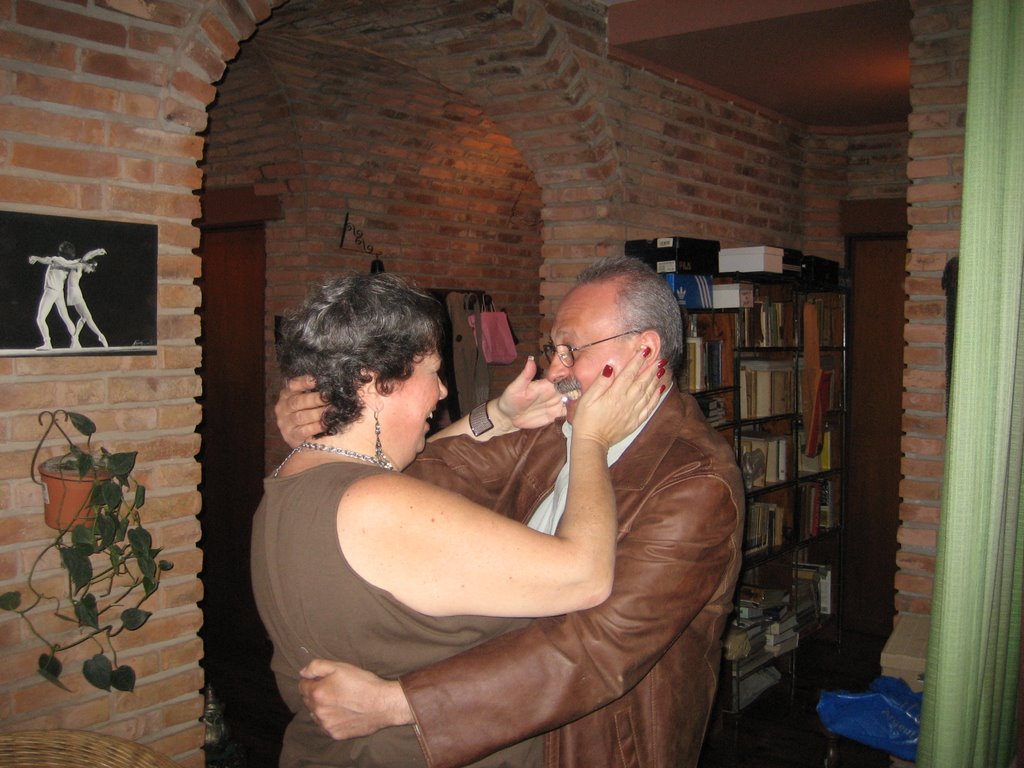
My mom greets a cousin she hasn't seen since her last time in Argentina, before I was born.


On Saturday, we had a big family reunion at my grandmother’s sister's house. It was great to see my mom and family smile as much as they did. The evening climaxed with everyone singing Argentine songs, including "Luna Tucumana" by folk legend Mercedes Sosa. My mom knew the words to the songs. She really felt at home. I, remember hearing the song at the Mercedes Sosa concert (the last concert performed at Teatro Colón, where my grandparents used to go on dates, before it closes for a few years for renovations). I of course, didn’t know the words.

Later that night, I ran into some Pennsylvanians at a bar and did a little Cleveland-Pittsburg football rivalry thing. It was nice getting to act out a script with people I don’t know. Granted, I could care less about football, but it was nice for a moment.

Sunday, November 26, 2006

Volunteering

At volunteer English teaching, a couple of French women and I taught a few lessons on numbers in English in a Comedor (soupt kitchen/community center type thing) in Zona Sur of Gran Buenos Aires. The kids were kind of silly, generally sweet and wanted to learn something. We had fun. It felt good to be teaching again. A few were syblings and they hit each other when they got frustrated. I may not have the imperative tense down, but the "teacher look" transcends all languages.

Saturday, November 25, 2006

My mom's old house

So my mom arrived in Buenos Aires on Wednesday. She hasn’t been here since before I was born. We visited the house that she lived in until she left Argentina at 16 in 1966. While anticipating her trip, my mom dreamt at night about entering her house, but didn’t expect to do so because her sister didn’t have luck with the residents who lived there a few years ago. Adina rang the bell anyway. Luckily, the house was being worked on. A painter let us come in and look around. I saw the bedroom my mom shared with her sister, the rooms where they lived (confined to one floor), the backyard etc. My mom told me that her father (who was and is a doctor) decided to leave Argentina in order to pursue greater economic opportunity. I haven’t been in the houses they lived in when they first got to the U.S., but the house my grandfather currently lives in is certainly much bigger than this one. We were all very, very happy to have this opportunity.

Wednesday, November 22, 2006

Documentaries make life better

I couldn’t help but rent “24 hour Party People” (which isn't actually a documentary, but historical fiction), as any semi-responsible student of the social sciences must understand the historical context of his or her cultural experiences. While I was being born in 1982, New Order record sales funded the legendary Haçienda nightclub in Manchester as the Argentine military junta tried unsuccessfully to wrest the Islas Malvinas from British control. As I saw many Malvinas-era Argentines doing in the documentary “Republica Perdida”, fans chanted “Argentina” before the New Order concert on Saturday. By the end of the show, they were chanting “New Order”.

Rock n' Roll - 1
Dictatorships - 0

My mom arrives soon.

Tuesday, November 21, 2006

Manchester comes to Buenos Aires


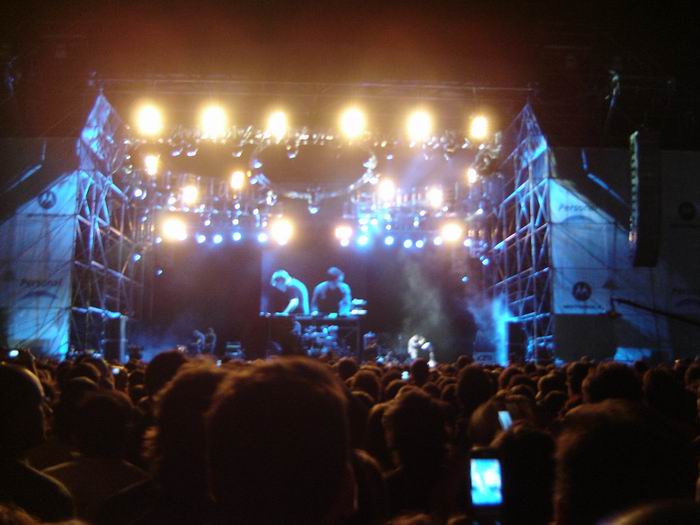
Last Saturday, I went to Personalfest, a very popular annual music festival here in Buenos Aires. I started at the main stage with Ian Brown of the Stone Roses and then strolled to the second stage for NYC's the Bravery. There is nothing like a tight pristine suit, wry pretentious lyrics (“Your words are like knifes in my ear”) and inflated egos to remind me of home (one of them, at least). My sister and I passed empathetic glances while a band member tried to thank the audience in Spanish.

As we returned to the main stage for New Order while the Bravery was still playing, my sister said “I hope they play that song about that about that soldier who wants to see his family." She got her wish. Lead singer Bernard Sumner (who turned 50 this year and dressed humbly for a rock star) announced that “Love Vigilantes” is a “vehimently anti-war song”.

Near the end of the show, a band member declared “Ian Curtis lives” before playing “Atmosphere” by Joy Division during the encore (after Joy Division lead singer Ian Curtis hanged himself, the remaining members formed New Order). I don’t know if it is just me, but “Love Vigilantes” always reminded me of “Atmosphere”. Sumner didn’t try to speak Spanish and he rightly assumed that Argentine fans would eagerly and aptly accept his invitation to sing along to the main verse of “Love Will Tear Us Apart”. Perhaps my expectations for New Orders synth super hits were too high, perhaps those songs depend too much on production or perhaps darkness is just beautiful; for me, the Joy Division songs stole the show.